
Know Your Farmer, Know Your Food
The decisions we have to make daily regarding buying fresh food for our families gets more complicated every day. Long ago, organic pioneer J. I. Rodale wrote, “One of these fine days the public is going to wake up and will pay for eggs, meat, vegetables, etc., according to how they were produced.” He further wrote, “It is not organic to produce milk organically, and then to pasteurize it.”
When researching who you want to purchase your food from, conduct thorough research inquiring about their farming practices, ensure they prioritize sustainable methods, humane animal treatment, and thoughtful land stewardship. Find a farmer who engages in organic, permaculture, or biodynamic farming. Support those farmers who have a small scale, personal relationship with their animals and who treat their animals with respect and kindness. By choosing a sustainable farmer, you’ll not only get high-quality products, but also contribute to a healthier way of farming.
If it’s raw milk, does the farmer use intentional risk-reduction practices, aim for high standards, and test their milk regularly to identify issues before they cause problems? Do they allow farm visits? Do they teach about their methods and why they chose those methods? Avoid buying raw milk from a dairy farmer who has both a traditional pasteurized dairy and is offering raw milk, unless they have two separate management systems. Milk meant for pasteurization should not be sold as raw milk.
Kraft
-
processed cheeses, natural cheeses, cream cheese, cottage cheese, sour cream, milk, ice cream
Nestle
-
coffee creamer, ice cream, “flavored” milk drinks
Land O’Lakes
-
milk, butter, margarine, cheese, ice cream, yogurt
-
soy oil
-
wheat flour
-
animal feed products
-
“ethanol co-products” – the residue from ethanol production
-
This residue is fed to today’s dairy confinement cows
-
Can we say repeat of the 1800’s swill dairies??
-
-
Land O’Lakes owns Purina Mills pet and livestock feeds
Dairy Farms of America
-
milk, “shelf-stable” milk, coffee creamer, condensed milk
-
cheese, butter
-
infant formula
-
nonfat dry milk powder, whey products
-
Starbucks Frappuccino drinks
Dean Foods
-
milk, coffee creamer, whipped toppings
-
dips, dressings
-
owns Borden, Meadow Gold, Nature’s Pride, Shenandoah’s Pride, Sealtest, Alta Dena (previously largest raw milk producer), and Adorh Farms
-
owns Horizon Organic Milk and soymilk maker White Wave
What is Raw Milk?
Raw milk is milk directly from livestock whether it be goat, sheep, or cow. Raw milk has not been pasteurized, homogenized, or processed in any way. Commercial milk, both in it’s past form and current form, is a vastly different product compared to raw milk produced for human consumption.
The debate on raw milk has a long history, with many outdated arguments against it. Both the US Food and Drug Administration (FDA) and the Centers for Disease Control and Prevention (CDC) caution drinking raw milk may pose significant health risks. Federal regulations restrict raw milk distribution across state lines unless intended for pasteurization or aged cheese production, but each state has its own raw milk laws. Current individual state laws can be found here. These laws continually evolve, with more states seeking to legalize raw milk.
There is no way to absolutely guarantee the safety of any food. The Raw Milk Institute, along with the help of other organizations, has demonstrated a high level of safety for raw milk. We attended the Raw Milk Institute raw milk training seminar last year to ensure we are always offering our customers the best products possible.
Organic
When it comes to whether your raw milk is organic or not, it’s important to note the term “organic” has been somewhat watered down as many organic brands are owned by larger food companies that may not be as committed to the organic philosophy as smaller, family owned farms are. These days, it generally means the livestock are fed an all-organic diet, and the farm refrains from using pesticides or herbicides.
Due to financial constraints, many small farms can’t afford to strictly adhere to an all-organic diet for their livestock as per legal definitions. In all honesty, if not for off the farm employment, we could not afford it either. Ironically, selling natural, organic whole food is more complex due to regulatory challenges, compared to selling “conventional”, chemically laden food which don’t require much. We purchased our farm six years ago and have been dedicated to maintaining real organic practices.
Antibiotics and Hormones
All milk purchased in the United States should be antibiotic free. Cows given antibiotics when sick aren’t milked again until the antibiotics are clear from their systems. Whether the milk you purchase contains hormones is a different story.
The use of rBST, a synthetic hormone given to increase milk production, is not regulated in the United States despite it being illegal in Canada and Europe. US farmers are not required by law to label milk from hormone treated cows. Farmers who choose not to treat their cows have begun to label their milk as “rBST-free” due to increased correlation between rBST and some cancers. Again, know your farmer, know your food. We do not use synthetic growth hormones. We prioritize holistic treatments over antibiotics, resorting to them only when absolutely necessary. Even our children, now adults, have only taken antibiotics twice throughout their lives.
Pasteurization
The process to collect milk, as well as the treatment of dairy cows, deteriorated in the late 1800s. The War of 1812 brought about distillery dairies which housed confined, abused, emancipated, and diseased cows. The dairy cows were fed acid waste products, known as swill, from the whiskey industry. The milk the cows produced often led to disease due to their diet and the conditions in which they were kept. The slop they were fed, an unnatural food for them, made the milk so defective it would not make cheese or butter. In most cases, the milk cows were tied in the same stall for 18 months. With this lifestyle, it was not unusual for 100 dairy cows to die monthly. Rather than treat the cows correctly, pasteurization was born. Modern confinement dairies continue to grow, and while the conditions generally are not as bad as those of the distillery dairies, many cows never leave their stalls and are often sick from mastitis and other ailments. These facilities still produce 70% of our milk in the United States.
Pasteurization is a heat treatment method designed to eliminate potential harmful bacteria from milk and lengthen its shelf-life. There are various versions of this procedure. High-temperature Short-Time (HTST) pasteurization heats milk quickly to at least 161.6 degrees, but only for a few seconds. In contrast, low-temperature pasteurization necessitates heating milk to 145 degrees for at least 30 minutes. The Ultra-Heat Treatment (UHT), or ultra-pasteurization, heats milk to 280 degrees for a few seconds, resulting in a shelf-stable product that can last 6-9 months. The ultra-pasteurization method is now widely used.
While it eliminates potentially harmful bacteria, pasteurization destroys lactase, an enzyme needed for milk digestion. It also eliminates beneficial bacteria, enzymes, and nutrients essential for a healthy gut biome. The dietary value of milk is lost. Low standards of milk production are encouraged. There’s no incentive for high-grade milk. Monopoly control of producers is made possible. Pasteurized milk became a heavily processed, allergenic food product and no longer the live, nourishment our bodies require.
“Man is the only creature that consumes without producing. He does not give milk, he does not lay eggs, he is too weak to pull the plow … yet he is the Lord of all animals.”
— George Orwell, Animal Farm, 1945
Homogenization
Homogenization is a separate process separate from pasteurization. The milk is heated again and forced repeatedly into small holes in an effort to break down the fat molecules. This process allow the broken fat molecules to stay suspended in the milk and resist separation. While homogenization does not involve additives or chemical treatments, it alters the way our bodies absorb milk fat.
Fat Globule
US grocery stores offer various types of conventional milk, including whole milk, 2% reduced-fat, 1% low-fat, and skim fat-free milk. Whole milk has a fat content of 3.5%, whereas fat-free milk has less than 0.2%. When fat is removed, it is replaced with protein- and vitamin-rich skimmed milk powder or concentrate.
Dexter milk, similar to goat milk, has smaller fat globules and a naturally homogenized texture, causing the fat to stay suspended in the milk for longer. 60% of the bioactive elements found in raw milk are carried by the butter fat globule!
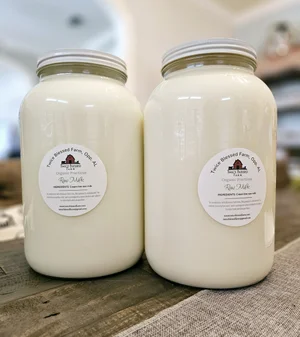
When you purchase our milk, you’ll observe a cream-line at the top. Scooping off this cream will reveal a new cream-line the next day as the cream in Dexter milk rises for longer periods. This unique characteristic can make Dexter milk more digestible for some people. Despite producing less volume, Dexters yield milk rich in butterfat content, ensuring superior quality over larger breeds.

Protein-Enriched
Non-fat dried milk added to low-fat milks is described as “protein- and vitamin-rich”. This additive compromises the nutritional quality of commercial milk. Production of non-fat dried milk involves forcing skim milk through tiny holes at high temperatures and pressures much like homogenization. This process not only destroys any nutrients left, but also causes nitrates —known potent carcinogens— and oxidizes the cholesterol in the milk. This increases the intake of substances that cause heart disease and cancer. Additionally, the body needs Vitamin A to assimilate protein. When you consume protein rich foods without the necessary fats, the body draws on the Vitamin A stored in the liver subsequently creating auto-immune diseases and cancer. Adding non-fat dried milk is a practice that spans the industry and is not regulated by the FDA nor does it require labeling.
Beta Casein
Should you care whether your milk is A1A1 or A2A2? We conduct tests for beta casein on our farm, but only out of curiosity and because the test is cheap when combined with additional tests. Beta casein does not factor into whether we milk that particular cow. In our experience most individuals diagnosed as lactose-intolerant to modern, conventional milk stems from traditional dairy herds diet of grain and soy, the pasteurization process, or the homogenization process. There are few individuals who have an allergy to the A1 beta casein. A survey commissioned by the Weston A. Price Foundation indicates about twenty-nine million Americans are diagnosed lactose intolerant, twenty-four million of whom could drink milk with no problems if raw milk were widely available.
Grass-Fed
Cattle fed mostly grain have a lower, more acidic intestinal pH and are more likely to harbor pathogenic bacteria than cattle fed mostly grass and hay. The resulting acid-resistant pathogenic bacteria have an increased ability to survive the human stomach and subsequently colonize and cause disease. This is another reason why raw milk (or meat) from grass-fed cows is so much safer than milk from animals kept largely or entirely in confinement and fed mostly grain.


Raw Milk Benefits
Germ theory is pivotal in the debate surrounding raw milk. The prevalent notion that germs cause illness leads some to view raw milk as a hazardous exposure to germs. A contrasting belief advocates illness results from the immune system’s inability to handle germs, emphasizing the importance of immunity-building, nutrient-rich foods. The basic choice that lies before you is whether to choose foods that are nutrient-dense, or foods that have been rendered sterile.
The medical community largely adheres to the germ theory, which assumes the human body is always sterile and healthy, and microbes are the culprits of diseases. Recent research, however, portrays the human body as a living organism teeming with trillions of microorganisms, mainly within the digestive tract and skin. Studies at the Institute for Genomic Research reveal the human body consists of 90% bacterial cells and only 10% human cells. The gut is the largest immune system organ in the body, and raw milk is the most anti-inflammatory food on Earth.
Raw milk is correlated with:
-
Easier digestion
-
Improved gut health
-
Reduced asthma
-
Reduced allergies
-
Reduced eczema
-
Stronger immune systems
-
Reduced respiratory issues
-
Reduced ear infections
Conventional medicine is full committed to the use of drugs rather than food in the treatment of illness. Further information regarding raw milk health benefits can be found here.
Raw Milk Risks
Many factors explain the emergence of pathogens — overuse of antibiotics, crowded feed-lots, low-quality and lost-cost animal feed, globalization of the food supply, and reduced human immunity due to poor nutrition.
For illness to occur four things must align:
-
Pathogen must be present
-
Pathogen must be virulent
-
Pathogen load must be high
-
Host must be susceptible
Possible Pathogens:
The scope of food-borne illnesses in the US is vast. Commercial eggs kill hundreds of Americans each year via Salmonella. On average 8% of commercial ground beef contain Salmonella and 12% contain Listeria. 30% of ground beef samples are contaminated with Staph and over half with Clostridium.
-
Salmonella
-
Ground beef is a common and persistent source of Salmonella, yet it is not illegal to eat
-
High levels of salmonella indicate high levels of fecal matter
-
The USDA regulations allow for 10% in ground beef samples
-
-
Campylobacter
-
Prevalent in poultry
-
Several cases related to raw milk but evidence in many cases were inconclusive
-
-
Listeria
-
Raw milk has not historically been associated with Listeria
-
Common is raw fruit, vegetables, and deli prepackaged foods
-
-
E coli 0157:H7
-
First identified in 1982
-
Only one case in 2001 involving raw goat’s milk
-
Commonly attributed to feedlot cattle and hamburger grinders
-
-
Tuberculosis
-
Tuberculosis (TB) was the major cause of death in the early 1900s. Many people believed it was being passed from the milk cows to people. Because pasteurization was known to kill the tubercle bacilli, this further strengthened the pasteurization debate. We now know that raw milk protects against TB.
-
Whether the bulk of tuberculosis traceable to raw milk in earlier times was the result of external contamination (unsanitary conditions; infected, tubercular workers) or lesions in the udders of cows racked with bovine tuberculosis, it’s difficult to say.
-
Tuberculosis is generally not found outside of feedlot cattle
-
-
Brucellosis
-
According to the National Library of Medicine, the unavailability of data specifying brucellosis cases acquired from raw milk consumption have precluded the direct association between raw milk and brucellosis prevalence in the United States
-
The vast majority of cases occur in meat-packers
-
Alabama is considered a brucellosis free state
-
Most cases in the US are attributed to pigs
-
The reclamation of our right to eat healthy foods will lead to a renewed awareness of legislature eventually. We have watched the argument go from ridicule to violent opposition with farm raids, sneaky legislation, and reports with outdated information. Are laws against raw milk fair? Are they even constitutional? Raw milk is deemed so dangerous that in over twenty states, you may not even purchase it from the farmer, much less find it in a store; however, raw milk is naturally the first food of every mammal on this planet.
Public health policy increasingly ignores the threat of contamination in foods produced by big business, while remaining biased against raw milk. Attempting to make all food sterile is not a valid goal. What would happen if authorities concerned themselves with quality as well as safety while protecting the public’s freedom to choose their food?
0 Comments